
It has been agreed between the European Union and the South American trade bloc (Argentina, Brazil, Paraguay and Uruguay) and seeks to stimulate Europe’s economy and global partnerships while protecting EU farmers, consumers, and environmental standards, in particular by:
- eliminating trade barriers;
- creating jobs and business opportunities;
- providing strong safeguards for EU standards and ensuring fair competition.
According to estimates, by 2040 from the entry into force of the EU–MERCOSUR Agreement, the following results are expected:
- more than €77.6 billion increase in the European Union’s GDP;
- up to €50 billion increase in annual EU exports (+39%);
- up to 600,000 additional jobs in Europe.
The impacts of this major trade agreement will result in tariffs reduction across various sectors. For example, for industrial products, a reduction in tariffs is expected on cars, machinery, and pharmaceutical products. As for agri-food products—such as wine and spirits, chocolate, and olive oil, to name a few—there will be significant positive effects, benefiting increased exports across most agricultural sectors:
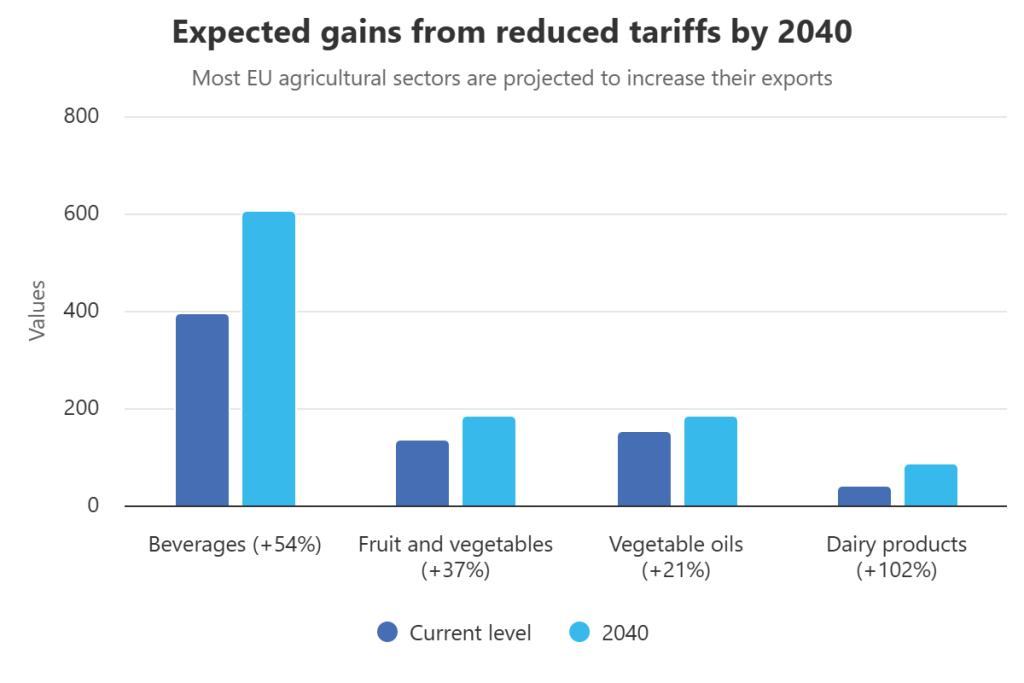
The agreement will support the growth of exports of traditional, high-quality EU agri-food products; safeguard authentic EU products (Geographical Indications); and limit preferential agri-food imports.
In particular, imports will be allowed only if they comply with strict EU food safety standards, with enhanced controls and inspections in exporting countries and at EU borders.
Among the most significant aspects of the agreement, especially regarding the agri-food sector, is the prohibition of imitation of over 340 traditional EU food products, including 57 Italian Geographical Indications (e.g., Aceto Balsamico Tradizionale di Modena, Asiago, Bresaola della Valtellina, Grana Padano, Prosciutto di Parma, Barolo, Franciacorta, Marsala, Grappa, Zampone di Modena, Pecorino Romano, and many others).
In recent weeks, the European Commission has announced its intention to proceed with the provisional application of the agreement, committing to ensuring its full conclusion in line with EU treaties.
Almost simultaneously with the approval of the EU–Mercosur agreement, Argentina (a Mercosur member country) signed a bilateral agreement with the United States, the so-called “ARTI” (Agreement on Reciprocal Trade and Investment), effectively legalizing “Italian Sounding” practices and putting at risk the protection of Italian PDO and PGI products.
Through a list of terms considered “generic,” this agreement aims to establish regulatory primacy that could render the protections provided by the Mercosur agreement ineffective, particularly in the agri-food sector.
Essentially, the agreement allows the use of terms identifying U.S. agricultural products if there is no evidence of a specific quality or reputation essentially attributable to geographical origin. These names include, for example, Asiago, Burrata, Fontina, Gorgonzola, Grana, Mascarpone, Parmesan, and Romano.
In other words, it is no longer taken for granted that “Asiago” is a protected product from the Veneto region; rather, unless proven otherwise according to the agreement’s criteria, the name may be considered a common, generic term for a type of cheese, regardless of the product’s origin.
This legislative move allows U.S. producers to market imitations of Italian excellence—such as Grana, Gorgonzola, Asiago, and Mortadella—within the Argentine market without facing sanctions for violating Designations of Origin.
A natural question arises, and the regulatory paradox is evident: how can Argentina (which, among other things, hosts one of the largest communities of Italian descent in the world) guarantee the protection of terms like “Parmigiano Reggiano” or “Asiago” within Mercosur if it simultaneously legally recognizes “Parmesan” and “Asiago” as generic names for U.S. producers?
This is therefore an agreement that, in effect, legalizes U.S.-origin Italian Sounding, turning names protected by the European intellectual property system and linked to specific territories into generic terms. This directly undermines the effectiveness of Geographical Indications (GIs) protected by the European Union in the South American market and compromises the stability of the EU–Mercosur agreement, due to a priority and incompatibility clause favouring the provisions of the “ARTI” Agreement, which is expected to enter into force well before the Mercosur agreement.
For further information on this topic, do not hesitate to contact our consultants with specific expertise in the sector.
